
Heating, ventilation, and air conditioning (HVAC) is a term we’ll use to cover all mechanical systems within a cabin (fresh air, make-up air, etc.). Unique environments make designing and installing cabin HVAC systems a little different than your standard home.
The first step here is to have your Manual J calculations completed by a professional. Often a supplier or installer will do these at a low or no cost on the promise you’ll buy the equipment from them. That said, avoid those who “napkin math” and oversized systems. It’s more difficult to find than those familiar with a Pretty Good House (PGH) standard and the drastic reduction in demand you’ll have as a result. Remember – it’s the cold starts of equipment that use the most energy. It’s far more efficient to have equipment that runs all the time and then kicks on-and-off.
Properly done, your Manual J calculations will consider your building envelope, glazing aspects, extreme weather, occupant count, and more. These calculations should guide every decision of your HVAC design.
HVAC Design for Cabins and Rural Homes
HVAC Energy Use
- Your HVAC system will likely be the largest consumer of energy in your home. And the system size and energy demands will be in direct correlation to the building envelope. This is exactly what we discuss in our guide on construction costs and the difference between operational and embodied costs.
- Buy the highest efficiency models you can afford. Oftentimes, that’s an air-sourced heat pump that is eligible for tax credits and/or rebates.
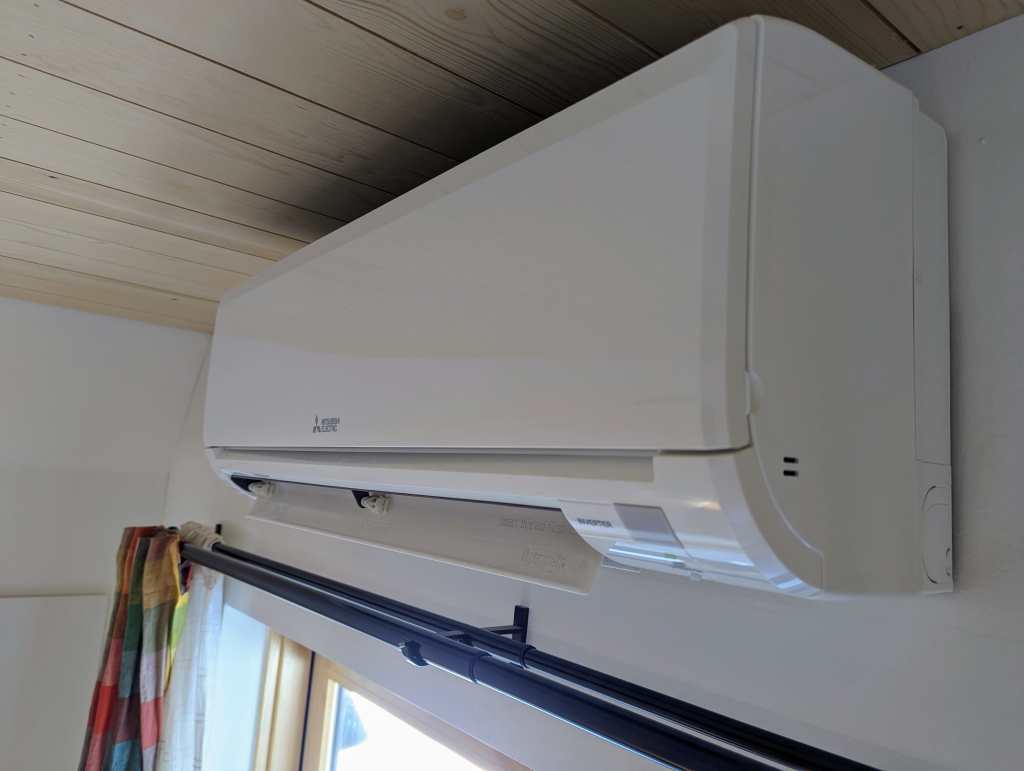
- Air-source heat pumps (sometimes called mini-splits or multi-splits) are incredibly efficient and have the option of being installed ductless. Ducts are inefficient and expensive to clean.
- Mini-split systems can both heat and cool a home, and one system is much more energy efficient and cheaper to install than two (furnace and air conditioner).
- Consider an all-electric home to avoid the need for fossil fuels. All electric also means backup power is also simplified.
Heating for Cabins
- Air-source heat pumps are incredibly efficient (even down to -15°F), affordable (especially if you’re building to the Pretty Good House standard), and easy to install.
- There’s a long-held myth that heat pumps don’t work in cold weather. We live where winter-time lows drop to -40°F regularly and we’ve had no issues with the combination of our PGH building envelope and an air-sourced heat pump. Our heat pump usually runs to -20°F before shutting off (less efficient below -13°F); and if temps will be sustained for several hours below that we have hydronic baseboard heaters and a wood stove as backup. But more often than not – it’s not necessary. We’ve found that below -20°F our cabin will only drop about 1°F per hour without the heat pump running.
- Particularly in cold climates consider installing a redundant/back-up heat source. Not just for heat pumps – but for any heat source. Even better if that source requires a different fuel (i.e. wood stove vs. electricity).
- Different heat sources have varying effects on humidity (i.e. wood stoves will dry the air considerably). Consider your heat sources and plan to supplement humidity if needed.
- Options for heat include:
- Air-sourced heat pumps – also called ductless systems, mini-splits, and multi-splits. See notes on these above.
- Ground-sourced heat pumps are efficient but require extensive excavation to install.
- Geothermal systems require hot springs or other unusually warm areas in the ground to work.
- Radiant heat does not handle temperature swings well (it has to change not just the temperature of the pipes – but the whole slab); requiring the space to be kept at a constant temperature. This may not be economical if the cabin is a second home.
- Furnaces (forced hot air) rely on ducts which can create vast inefficiencies (varying greatly depending on their installation location). However, the same duct system can be used for air conditioning.
- Hydronic uses liquid to provide heat. Radiant heated floors are a type of hydronic – as are the iconic wall radiators.
- Wood is a fine backup, but a poor primary heat source. See our guide on wood stoves for cabins.
Air Conditioning for Cabins
- It’s very common to head into the mountains and find older homes with no air conditioning because historically – it wasn’t needed. With climate change – this is no longer the case. Plan in a way for air conditioning (ducts or ductless – placement of line sets, drains, power, and condenser) at the time of construction even if you don’t install it right away.
- Better yet – use an air-source heat pump system to heat your home and air conditioning comes with it!
Humidity in Cabins
- Relative humidity inside your home should ideally be between 20-60%. 45% seems to be the sweet spot where you’re not dealing with the health effects of dry air or the mold and fungus threats of surplus humidity.
- For desert and mountain cabins, you’ll likely be looking for ways to add humidity (humidifier, swamp cooler) – while those in humid environments will be looking for a way to remove or reduce it.
- Most of the humidity in a home is generated by the occupants (cooking, cleaning, bathing, breathing, pets, etc.). Properly engineered HVAC systems will account for all this with the heating, air conditioning, and ventilation equipment.
- Air conditioners (heat pumps) will help remove and maintain humidity.
- Standalone dehumidifiers can use huge amounts of energy. If you choose to use one – look for one that is ENERGY STAR certified.
Ventilation for Cabins
- In a PGH, you’re likely going to have an issue when you begin exhausting air (laundry, cooking range, bath fan, etc.) with the house pressure becoming negative without any kind of make-up air. Make-up air should be part of your HVAC system design and can be as simple as a manual, passive duct; part of your ERV/HRV system; or a standalone system connected to each appliance.
- Many bath and range fans include a damper – it’s best to install a primary damper at the exterior wall. This not only increases the efficiency of the building envelope but is a great deterrent to pests.
- Especially in humid and cold climates – ensure ductwork slopes to the exterior so any condensation runs out and doesn’t pool and mold in the ductwork.
- Review our guidelines for roofing and avoid roof penetrations at all costs.
- Ensure you’ve reviewed our guidelines for building in a wildfire area.
HVAC Maintenance
- Carefully review ventilation options (make-up air, ERVs, HRVs, etc.) and select from those that are easily serviceable and will operate properly in your climate all year long.
- All HVAC equipment requires regular maintenance. Consider the placement of mini-split heads, ERV/HRV filters, etc. and ensure they’re easily accessible.
- Consider low or no-maintenance systems (i.e. go ductless so there’s no need to clean ducts).
- Carefully consider the placement of components (outdoor condenser, drain lines, etc.) so they don’t require any maintenance in any season. Living somewhere remote means that if you’re not around – no one is and things like a frozen drip pan or snow shedding onto an outdoor unit leave you without heat at the worst time.
HVAC Installation for Cabins and Rural Homes
- Regardless of your preference for manufacturers, select from your local stocking dealer. Most companies will install any brand – but only warranty their preferred manufacturer. Further, many systems will have regular maintenance items that need to be replaced (i.e. filters), and sourcing these anywhere but locally can be a real pain.
- If you’re installing yourself – Build.com has a large HVAC catalog and free shipping.
- Consider extended warranties if for no other reason than to ensure you’ll be able to get service! A service company may simply say “no” to trekking into your neck of the woods without the extended warranty contract.
 Pretty Good Builder
Leave a comment