
Most of your rural builds are going to be dependent on a well or cistern for drinking water. In other words, you’re going to be your own water company.
Well and Cistern Systems for Drinking Water
There are a handful of things a municipal water source provides that you’ll need to replicate or replace if you’re your own water company.
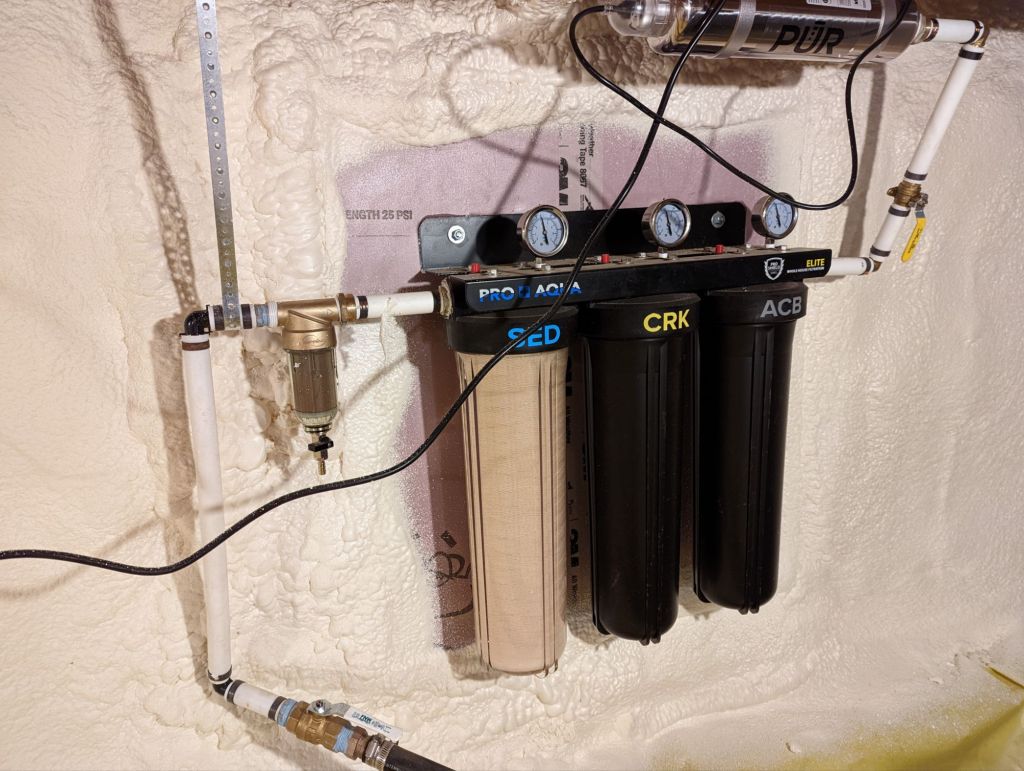
- Water Filtration – In addition to cleaning the water for consumption, a good filtration system will also prolong the life of your appliances and fixtures; as well as, prevent stubborn rust and mineral stains.
- For the reasons above and in consideration of things like making ice – treat the water as it enters the home.
- At a minimum, consider a sediment trap, three-stage filtration system, and UV light.
- Water testing – Test your water regularly with at home kits – and annually through a professional lab.
- Gravity-fed – Most municipal water is piped to your home through gravity. This means regardless if you have power – you’ll have water. That’s not the case with a well or cistern that relies on electric pumps. Consider a backup power source or more simply a backup, gravity-fed water source of your own. For example, using a traditional water heater with a tank versus a tankless model will store dozens of gallons of water in a power outage that can be accessed through the drain bib and a hose. Note, however, that you need to keep the tank at 130-140°F to prevent Legionella and other bacteria from growing. If you choose to keep your hot water tank above 120°F you’ll need to install thermostatic mixing valves at each fixture to prevent scalding. Learn more about waterborne germs on the CDC website.
Caring for Your Water Source
- Since you own your own water source – it’s in your best interest to preserve it. One way is to control what you put down the drains – have a look at our septic system care guidelines.
- Use low-flow fixtures and toilets to minimize water usage. See our choosing plumbing fixtures guide.
- Consider native plants that don’t require any irrigation or fertilizer. Remember, anything you put on the ground will eventually end up in your well.
Leaving for Extended Periods
A lot of rural buildings are cabins or vacation homes that will go unused for weeks or months at a time. In cold climates, this means you must either continue to heat the home (and hope the power doesn’t go out) – or design in an easy way to gravity drain all water lines in the home. Along those same lines, if you have the option, install all lines in a space that is unlikely to ever freeze and where they’re exposed for repairs and updates (like a conditioned crawl space or basement).
Choosing Fixtures
We have a guide to choosing fixtures that you should review as you design your system. Build.com has a huge selection of quality fixtures and offers free shipping.
Cabin Plumbing Installation
There isn’t much unique about the plumbing installation in rural areas. The biggest is to ensure that you install a locate wire with your water line. This will make finding it later much easier. Often this is overlooked since it’s not likely required and a water company isn’t involved.
If you’re in a cold climate, there are also a few things you might want to do a bit differently.
- Meet or better yet exceed frost depths for all water lines.
- Run water lines in a place where (1) they won’t be driven over (like a driveway) and (2) won’t be cleared of snow (snow is an excellent insulator).
- “Blue box” – or use rigid insulation to cover water lines before you bury them. Frost creeps into the soil from the surface down and insulating above a water line will help keep the soil around your water line warmer.

 Pretty Good Builder
Leave a reply to Hello, World. – The Pretty Good Builder Cancel reply